The numbers on a steel mill certificate are not a description of the metal. They are a record of decisions made in the steelmaking shop. Carbon content, manganese, sulphur, phosphorus, and the residual elements that affect weldability are all set before the steel is ever cast. Inspection later confirms the outcome. Steelmaking is where the outcome is decided.
This bulletin works through what steelmaking actually does. It covers what the process has to achieve, the raw materials it starts from, the routes used to make steel today, the chemistry of refining, and where the final composition and cleanliness are set. It closes on why all of this matters to anyone who welds, fabricates, or inspects steel.
Steelmaking is the conversion of pig iron, or a charge of scrap, into steel of a specified composition and temperature. In plain terms, it is the controlled removal of the things you do not want and the controlled addition of the things you do.
Pig iron from the blast furnace is not steel.
It carries too much carbon, typically around 4 percent, along with silicon, manganese, phosphorus, and sulphur picked up from the ore and the coke. Left alone it is hard and brittle and of little structural use.
Steelmaking has five jobs. Remove the impurities. Bring carbon down to the specified range. Adjust composition by adding ferroalloys. Control temperature so the steel can be cast. Produce clean, sound steel with the properties the grade demands.
The first four are chemistry and heat. The fifth, cleanliness, is about what is left behind. Non- metallic inclusions, dissolved gases, and residual elements all degrade properties if they are not controlled. A grade is not only its target carbon and manganese. It is also the impurities that were kept out.
Every heat starts from a charge. The mix depends on the route, the grade, and what is available.
Hot metal, the molten pig iron from the blast furnace, is the primary feed for the oxygen route. Steel scrap is charged alongside it, and is the main feed for the electric route. Direct reduced iron, made by reducing iron ore in the solid state, is an increasingly common scrap substitute where clean feed is needed.
Fluxes, mainly burnt lime and dolomite, are added to form the slag that captures impurities. Oxidising agents, oxygen and air, drive the refining reactions. Ferroalloys, added late, bring the composition to the target. The combination is not fixed. It is selected to suit the process and the steel grade being made.
Two routes make almost all of the worlds steel. A third, the open hearth, is effectively obsolete and is described here only for context.
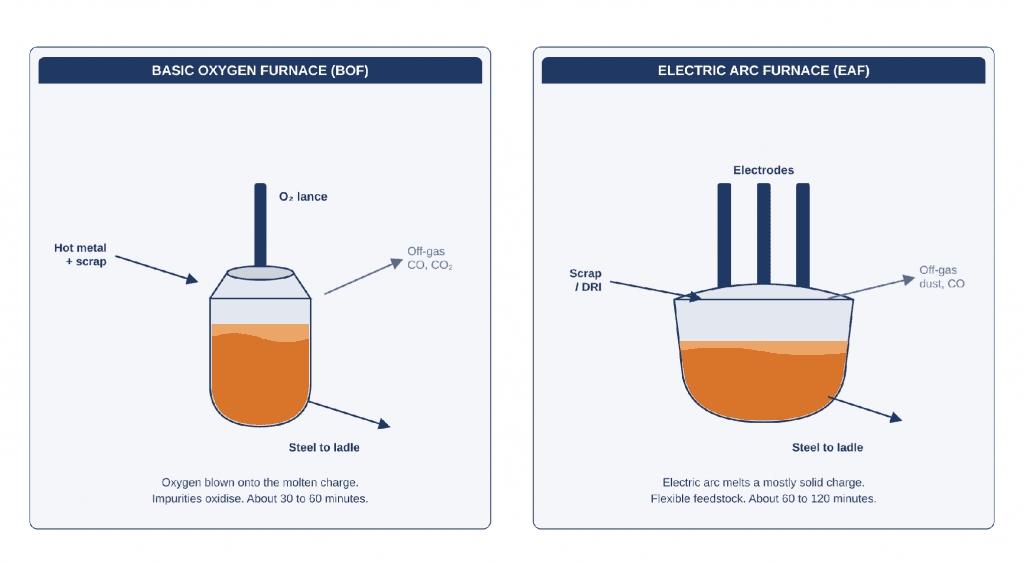
Figure 1: The two routes that make almost all steel today. Both refine the charge by oxidising impurities out of the metal. Timings are representative.
The basic oxygen furnace, also called the LD process, refines a charge that is mostly molten hot metal with some scrap. A water cooled lance blows high purity oxygen onto the bath. The oxidation reactions are strongly exothermic, so no external heat is needed. A heat takes about 30 to 60 minutes. The route is fast, cheap to run, and dominant for bulk carbon steel.
The electric arc furnace melts a charge that is mostly solid, usually scrap or direct reduced iron. Heat comes from an electric arc struck between graphite electrodes and the charge. The route is flexible, handles high scrap fractions, and gives precise control of carbon and temperature, which suits alloy and stainless grades. A heat takes about 60 to 120 minutes. The electric route is growing as scrap based steelmaking expands.
The basic open hearth furnace heated the charge with burning fuel and refined it slowly over several hours. It produced good steel but was too slow and too energy hungry to survive. It has been replaced by the oxygen and electric routes and is no longer built.
Both surviving routes do the same fundamental job. They oxidise impurities out of the metal.
Refining is oxidation. Oxygen, blown in or supplied through the slag, reacts with the impurities in the bath. Each impurity goes to one of three places.
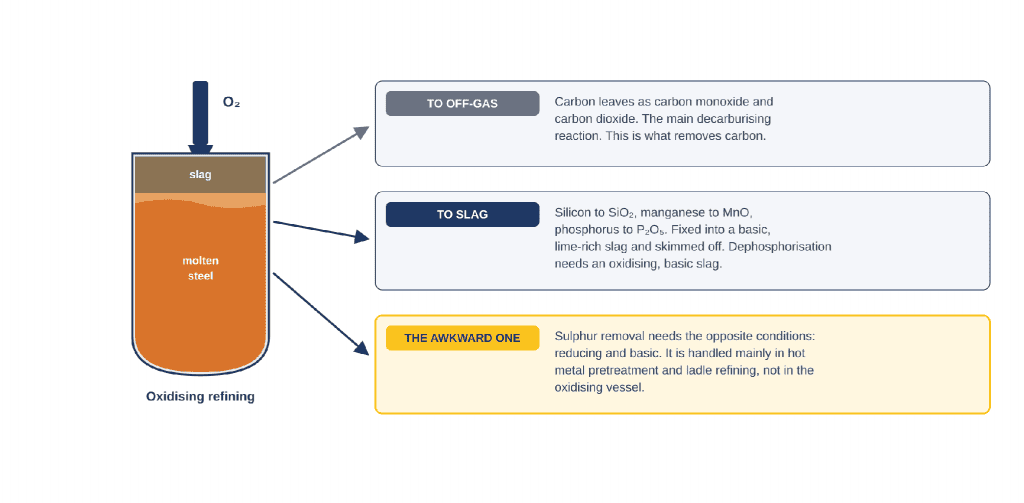
Figure 2: Oxidation refining sends each impurity to one of three places. Sulphur is the exception and is handled separately. Schematic.
Carbon leaves as a gas. It oxidises to carbon monoxide and carbon dioxide, which bubble out of the bath. This is the decarburising reaction, and it is what brings carbon down from around 4 percent to the fraction of a percent a steel grade requires.
Silicon, manganese, and phosphorus go to the slag. Silicon oxidises to silica, manganese to manganese oxide, and phosphorus to phosphorus pentoxide. The lime in the slag fixes these oxides so they can be skimmed off. Dephosphorisation in particular needs an oxidising bath and a basic, lime rich slag.
Sulphur is the awkward one. This is worth stating plainly, because process diagrams often imply sulphur is removed in the same step as everything else. It is not. Sulphur removal needs reducing conditions and a basic slag, which is the opposite of the oxidising conditions that remove phosphorus. You cannot do both well at the same time in the same vessel. Sulphur is therefore controlled mainly by hot metal pretreatment before steelmaking and by ladle refining afterwards, not in the oxidising furnace itself.
That distinction matters later, because sulphur is the element most associated with poor through thickness ductility and lamellar tearing in welded plate.
The furnace does the heavy refining.
It does not finish the steel. The steel is tapped into a ladle, and the final composition and cleanliness are set there, in what is called secondary metallurgy or ladle metallurgy.
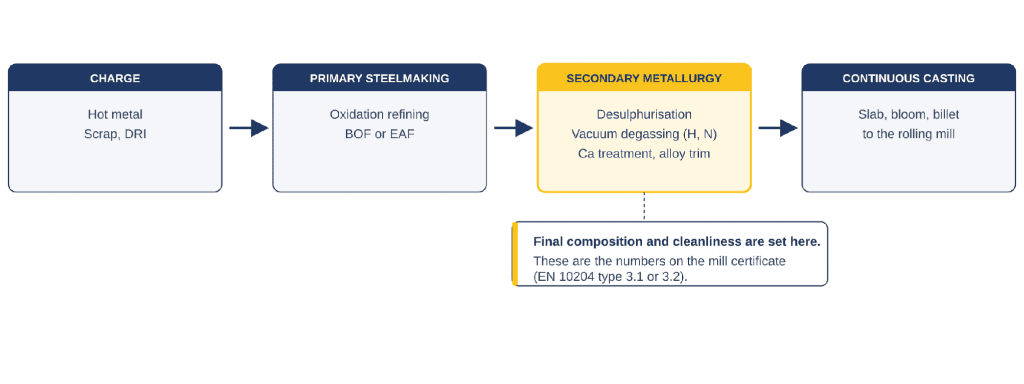
Figure 3: Final composition and cleanliness are set in the ladle, not the furnace. The mill certificate records that outcome.
Several things happen in the ladle. Argon is bubbled through to stir the bath and float out inclusions. Slag is removed and a fresh, reducing slag is built to take out sulphur. The steel can be vacuum degassed to strip dissolved hydrogen and nitrogen. Calcium is added to modify the shape of the remaining inclusions so they do not form harmful stringers. Ferroalloys trim the composition to target. Temperature is adjusted ready for casting.
This is not a minor finishing step. It is where a heat moves from roughly refined to on specification. The hydrogen removed here is the same interstitial hydrogen that causes cracking in welds. The inclusion control done here is what gives a plate its through thickness ductility. The values that end up on the mill certificate are set in the ladle, not the furnace.
The steel is then cast, almost always by continuous casting, into slabs, blooms, or billets for rolling.
A typical carbon steel leaves steelmaking within well understood ranges. Carbon sits between about 0.02 and 1.5 percent depending on grade. Manganese runs to around 1.5 percent. Silicon is usually below 0.5 percent. Phosphorus and sulphur are held low, commonly to 0.025 percent and 0.015 percent or below, because both harm toughness and weldability. Other elements, chromium, nickel, molybdenum, and vanadium, are added as the grade requires.
Two by-products come out alongside the steel. Slag, rich in the oxides of calcium, silicon, iron, manganese, and phosphorus, is used in cement and road construction. Off-gases, mainly carbon monoxide and carbon dioxide with dust, are captured for cleaning and energy recovery. Steelmaking slag is not the same material as blast furnace slag and is handled separately.
Everything a fabricator and an inspector deal with downstream is inherited from steelmaking.
Composition sets weldability. The carbon equivalent value, calculated from the composition on the mill certificate, drives preheat and the risk of hydrogen cracking. Two plates with the same yield strength but different compositions can behave very differently under the torch.
Sulphur and inclusion control set through thickness behaviour. Steel loaded through its thickness, in heavy welded connections for example, can suffer lamellar tearing if sulphur and inclusions are not controlled. This is exactly what BS EN 10164:2018 addresses, with its Z15, Z25, and Z35 through thickness quality classes, and it traces straight back to the cleanliness achieved in the ladle.
The route leaves a fingerprint. Scrap based electric steelmaking can carry residual, or tramp, elements such as copper, tin, and nickel that arrive with the scrap and cannot be oxidised out. These residuals affect weldability and hot ductility, which is a reason composition has to be checked, not assumed.
The mill certificate records the outcome. Under BS EN 10204:2004, a type 3.1 or type 3.2 inspection certificate is the documentary evidence of what the steel actually is. It is only as good as the verification behind it.
NECIT does not make steel. Our work begins where steelmaking ends, at the point where the certificate has to be trusted and the material has to perform in fabrication.
Vendor Inspection.
Under our ISO 17020 accreditation, our vendor inspection division verifies material certification at the point of supply and at the fabricator. We check that the inspection certificate matches the order, that the grade and cast analysis are consistent, and that the document type, 3.1 or 3.2 under BS EN 10204, is the one the contract requires. For plate loaded through its thickness, we confirm that the BS EN 10164 Z grade is specified and certified. Where residual elements matter, we check that they are reported, not left blank.
Welding Certification.
Composition decides how a steel welds. Under ISO 17024 we certify welders and operators to BS EN ISO 9606-1. Separately, under ISO 17020, we witness welding procedure qualification, including the mechanical testing, on the parent material as supplied. A procedure qualified on one cast does not automatically cover a steel of different composition, and the carbon equivalent on the certificate is part of that judgement.
NDT and Testing.
Cleanliness and soundness from steelmaking carry through to what NDT can find. Our UKAS accredited NDT division applies the method suited to the material and the flaw, including magnetic particle inspection, dye penetrant inspection, ultrasonic testing, phased array ultrasonic testing, and eddy current inspection. Personnel are certified to BS EN ISO 9712. Ultrasonic inspection in particular depends on the cleanliness and grain structure that steelmaking produced.
Where parent composition raises questions for welding procedure development or metallurgical investigation, that work sits with the Welding Development Centre, our sister company.
Steel does not arrive as a blank sheet of properties. It arrives carrying every decision made when it was refined and cast. Reading a mill certificate well, and verifying it properly, starts with understanding what put those numbers there.
NECIT: when what’s built must not fail.
Ahindra Ghosh and Amit Chatterjee, Ironmaking and Steelmaking: Theory and Practice, PHI Learning, 2008.
ASM International, ASM Handbook, Volume 1: Properties and Selection: Irons, Steels, and High-Performance Alloys, ASM International, Materials Park, OH, 1990.
H.K.D.H. Bhadeshia and R.W.K. Honeycombe, Steels: Microstructure and Properties, 4th ed., Butterworth-Heinemann (Elsevier), 2017.
