The weld metal gets the attention. The heat affected zone is where many welds fail.
The heat affected zone, or HAZ, is the parent metal beside the weld that never melted but was heated enough to change. It is not weld metal. It is not unaffected parent metal. It is a band of altered microstructure left behind by the welding thermal cycle.
Every point in the HAZ reached a different peak temperature. That one fact explains the whole zone. Nearer the fusion line the peak temperature is higher, and the change is greater.
This bulletin sets out what each subzone is, how heat input changes the grain structure in each one, and what that does to the properties an inspector verifies: hardness, impact toughness and tensile strength.
The HAZ is read against the iron carbon transformation temperatures. Two matter most. Ac1, near 727 degrees Celsius, is where steel begins to form austenite on heating. Ac3, which depends on carbon content and sits near 850 to 900 degrees Celsius for low carbon steel, is where that transformation completes.
Working out from the fusion line, the zone divides into four regions.
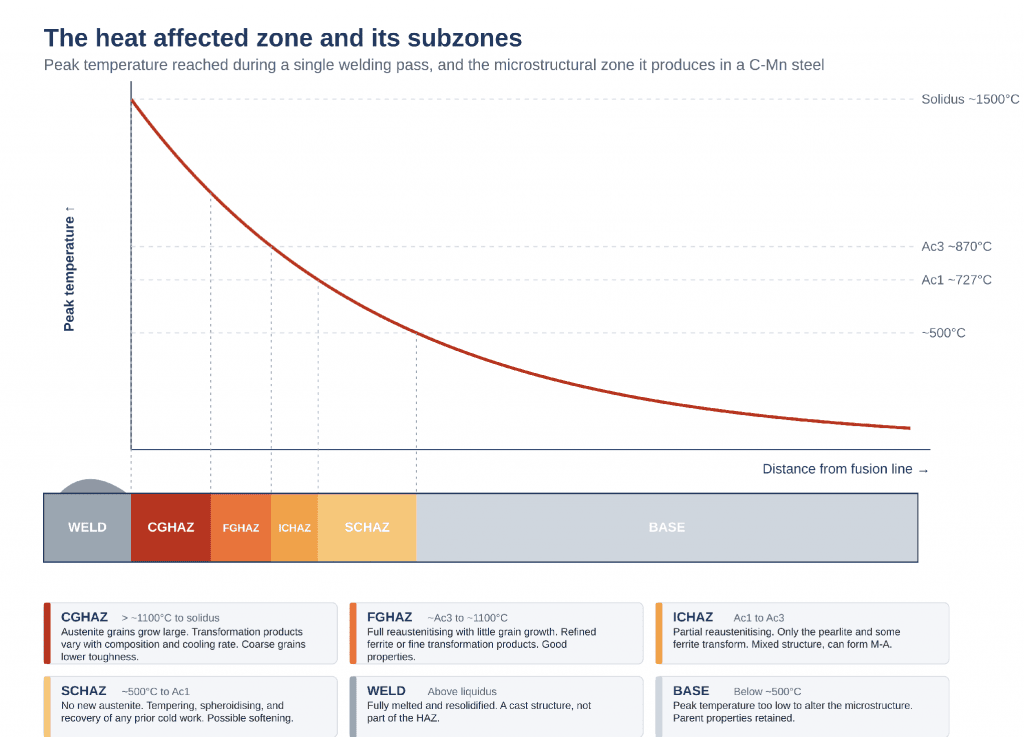
Figure 1: The subzones of the heat affected zone, set against the peak temperature reached during a single welding pass in a C-Mn steel. The temperature boundaries are shown for illustration only.
Coarse grained HAZ. This sits closest to the weld. Peak temperatures run from roughly 1100 degrees Celsius up to the solidus. The steel is fully austenitic, and the grains have the time and temperature to grow large. On cooling, those coarse austenite grains transform into microstructures set by composition and cooling rate, which may include ferrite, bainite, martensite or mixtures of these. Coarse grain size lowers toughness whatever the transformation product. In many carbon and low alloy steels this region carries the highest hardness in the joint.
Fine grained HAZ. Just beyond it, peak temperatures sit between Ac3 and about 1100 degrees Celsius. The steel fully reaustenitises, but there is little time for grain growth, so the grains stay fine. The result is a refined structure with good strength and good toughness. It is the best behaved part of the HAZ.
Intercritical HAZ. Here the peaks fell between Ac1 and Ac3. Only part of the structure reaustenitises. The pearlite and some ferrite transform, the rest does not. On cooling this gives a mixed structure, and in some steels it forms hard islands of martensite austenite constituent that lower local toughness. In high strength pipeline and offshore steels the intercritical HAZ is often the most critical region for toughness for this reason.
Subcritical HAZ. The peaks here were below Ac1, down to about 500 degrees Celsius. No new austenite forms. Instead any existing hard structure is tempered, carbides spheroidise, and any prior cold work begins to recover. In thermomechanically processed and quenched and tempered steels this subcritical softening can become the controlling design concern.
A note on terms. The fine grained region is sometimes labelled the recrystallised zone. That is loose. The refinement here comes from transformation through austenite and back, not from the recrystallisation of cold work. True recrystallisation of prior cold work happens lower down, in the subcritical zone. The distinction matters when the parent plate arrives in a cold worked condition.
Peak temperature fixes where each subzone sits. The cooling rate fixes what forms inside it.
Heat input is the energy delivered to the joint per unit length of weld, in kilojoules per millimetre. It rises with arc voltage and current, and falls as travel speed increases. The calculation also applies a thermal efficiency factor that varies with the welding process. BS EN 1011-2 gives the method for ferritic steels.
The useful measure is the cooling time from 800 to 500 degrees Celsius, written t8/5. That is the range in which austenite decomposes, so it controls the microstructure that results. In other words, the cooling rate, not the peak temperature, decides what forms on the way down.
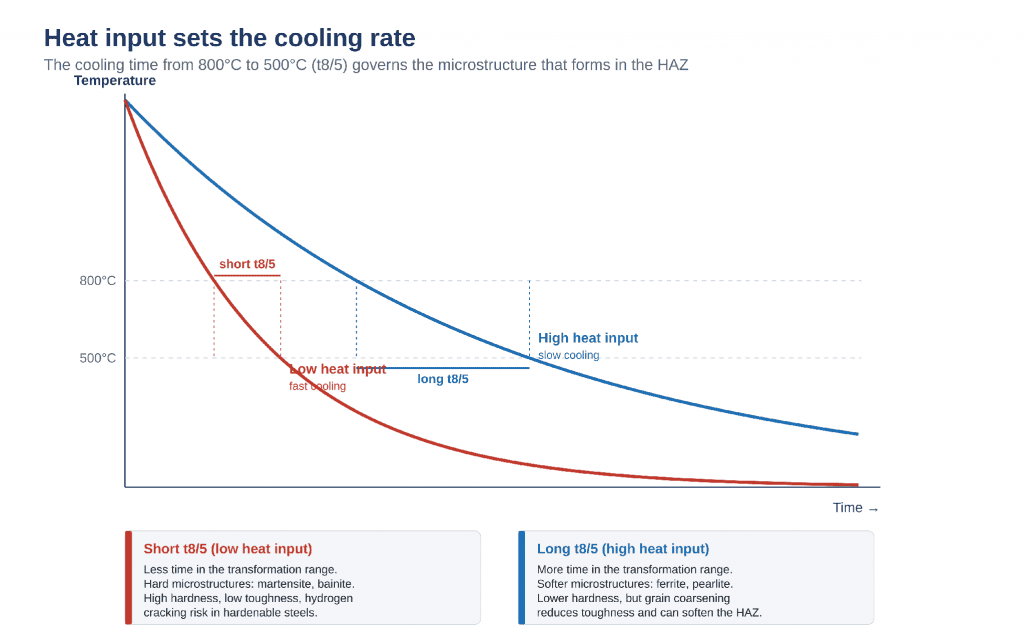
Figure 2: Heat input controls the cooling rate. A longer cooling time from 800 to 500 degrees Celsius (t8/5) gives a softer microstructure; a shorter t8/5 gives a harder one.
Raise the heat input and t8/5 lengthens. The joint cools slowly, and softer products form: ferrite, pearlite and coarser bainite. Lower the heat input and t8/5 shortens. The joint cools fast, and harder products form: fine bainite and martensite.
Preheat and elevated interpass temperature both lengthen t8/5 without changing the arc energy. Interpass temperature also drives the reheating and tempering of earlier passes during multipass welding, so the two are related but not identical.
The two extremes pull in opposite directions, and they act on the whole HAZ at once.
High heat input. The HAZ runs hotter for longer. The coarse grained region grows coarser still. The fine grained region widens. Hard transformation products give way to softer ones, and hardness falls. The risk shifts away from cracking and towards coarse grain embrittlement and softening of the subcritical zone.
Low heat input. The HAZ is narrow and cools fast. The coarse grained region forms hard martensite, and hardness climbs. The risk shifts towards a brittle untempered structure and towards hydrogen cracking, which needs hard microstructure, hydrogen and restraint to occur.
Neither extreme is safe. The task is to hold the heat input inside a band that avoids both.
Hardness is the quickest read on what the thermal cycle did. A hardness traverse runs a line of indentations across the parent, the HAZ, the weld and back out.
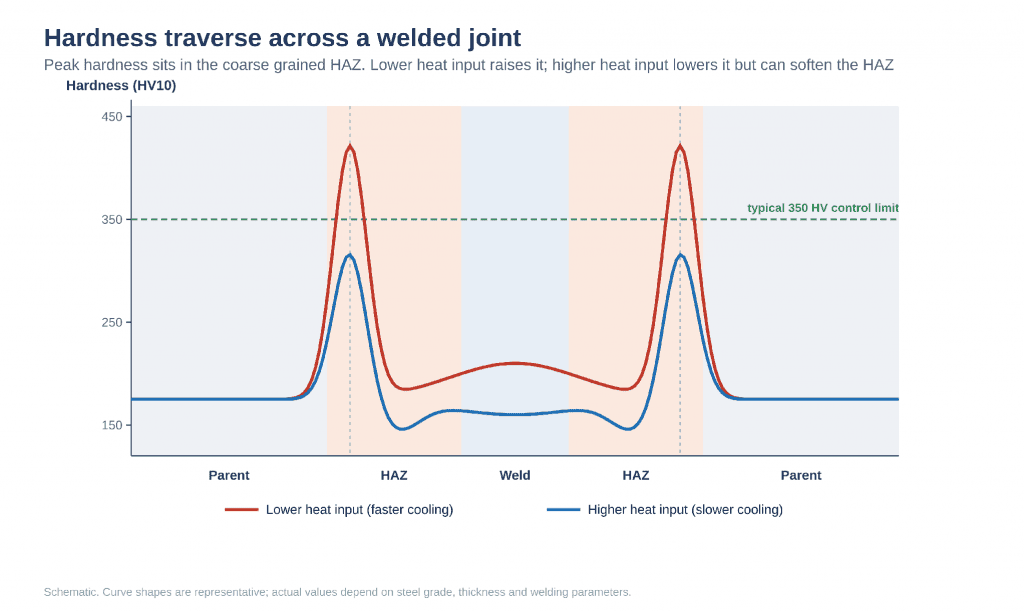
Figure 3: A hardness traverse across a welded joint. The peak sits in the coarse grained HAZ. Lower heat input raises it; higher heat input lowers it but can leave a soft zone. Real profiles are often asymmetric between cap and root.
In most ferritic carbon and low alloy steels the hardness peak sits in the coarse grained HAZ, just inside the fusion line. Lower heat input raises that peak. Higher heat input lowers it.
Most fabrication codes cap HAZ hardness to control hydrogen cracking and brittle fracture. A common limit is 350 HV10. Sour service is stricter, often 248 HV10 under ISO 15156, because hard structures are vulnerable to sulphide stress cracking.
Push the heat input too low and the coarse grained peak breaches the limit. Push it too high and the subcritical zone can soften below the parent. Both are findings a hardness survey will catch.
Toughness is measured by the Charpy test, and the HAZ is where it is most at risk.
The coarse grained HAZ is the usual weak point. Coarse prior austenite grains and brittle constituents lower the absorbed energy, and the effect is worst at low temperature.
Both heat input extremes reduce toughness, for different reasons. Too little heat leaves hard, untempered martensite. Too much heat coarsens the prior austenite grains, which lowers crack arrest capability and promotes cleavage fracture at low temperature. The best toughness sits in between.
Multipass welding adds a further trap. Where a later pass reheats an earlier coarse grained region into the intercritical range, it can form brittle martensite austenite islands. These local brittle zones can fail at toughness levels well below the surrounding metal. They matter most in thick section steels qualified for low temperature service.
The cross weld tensile test pulls a specimen across the joint. The failure load must meet the minimum tensile strength set by the applicable qualification code.
In ordinary strength carbon manganese steels, heat input has limited effect on this test. The weld metal is usually matched or overmatched, and the HAZ keeps enough strength.
High strength steels are different. Thermomechanically processed and quenched and tempered grades carry their strength through a controlled microstructure. Too much heat input erases it. The subcritical and intercritical HAZ soften, and the cross weld tensile can then fail in that soft zone, below the specified minimum.
This is why a grade cannot be substituted on yield strength alone. Two steels with the same specified strength can respond to welding heat in completely different ways.
Put the three properties together and the picture is a window, not a target line.
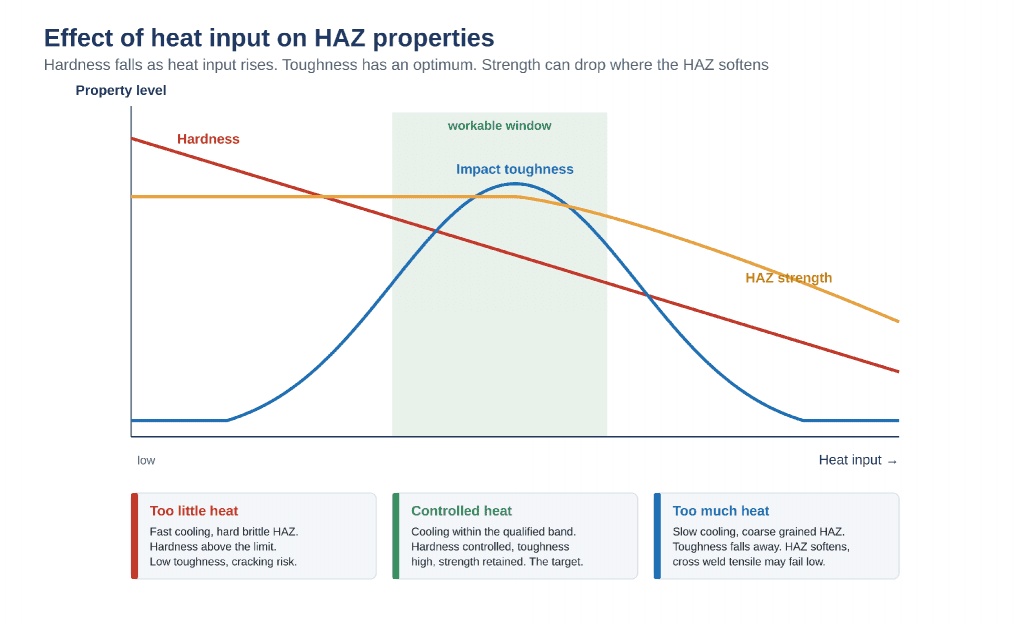
Figure 4: The effect of heat input on HAZ properties. Hardness falls as heat input rises, toughness has an optimum, and strength drops once the HAZ softens. The workable window is where all three are acceptable.
As heat input rises, hardness falls steadily. Toughness rises to an optimum, then falls as the grains coarsen. Strength holds, then drops once the HAZ begins to soften.
The workable window is the band of heat input where hardness is under the limit, toughness meets the requirement, and strength is retained. It is narrower for high strength and thick section steels than for mild steel.
Finding that window is the purpose of welding procedure qualification. Confirming that the weld stayed inside it is the purpose of inspection.
Several cracking mechanisms sit in the HAZ rather than the weld.
Hydrogen cracking forms in a hard HAZ when hydrogen and restraint are present. Low heat input, no preheat and damp consumables are the classic causes.
Lamellar tearing is not strictly a HAZ mechanism. It runs in susceptible parent plate beneath the weld, where through thickness strain pulls apart elongated non metallic inclusions. It is a risk in thick sections loaded through the plate.
Reheat cracking appears during post weld heat treatment of some creep resistant and low alloy steels, in the coarse grained HAZ. The same coarse grains that lower toughness make this zone vulnerable.
The HAZ is not a detail. It is where the welding thermal cycle leaves its mark, and it is often the weakest part of the finished joint.
Heat input is the lever. The welder sets it through voltage, current and travel speed. It decides the grain structure in every subzone, and through that the hardness, the toughness and the strength.
Get it wrong in either direction and the joint can pass a visual check while carrying a hard brittle zone, a soft zone, or a local brittle zone that only testing will find.
The risk is not theoretical. An invalid HAZ can fail a Charpy requirement, fail a hardness survey, or fail in service under fatigue or at low temperature.
NECIT Services operates across three accredited divisions to verify that the HAZ a procedure produces is the HAZ the design assumed.
Welding Certification. Heat input is a qualified variable. Within our accredited inspection scope and recognised third party approval services, we witness welding procedure qualification testing to the code that governs the work, whether BS EN ISO 15614-1, ASME IX or AWS D1.1. The qualification fixes the heat input range, the preheat and the interpass temperature, and the mechanical testing confirms the HAZ that results. Each test runs to a named method. Hardness traverses are taken to BS EN ISO 9015-1 or ASTM E92, Charpy impact tests with the notch placed on the fusion line and in the HAZ to BS EN ISO 9016 or ASTM E23, and transverse tensile tests to BS EN ISO 4136 or ASTM E8/E8M. Those are the zones this bulletin describes. Separately, our ISO 17024 accreditation covers certification of the welders and operators, again to BS EN ISO 9606-1, ASME IX or AWS D1.1 as the contract requires.
Vendor Inspection. Our Vendor Inspection division witnesses welding, heat treatment and testing at manufacturing facilities worldwide. For high strength, thick section and low temperature steels, the heat input record and the HAZ test results are the evidence that the procedure was followed and that the soft zones and brittle zones were avoided. The scope covers structural steelwork under EN 1090, pressure equipment under the Pressure Equipment Directive and the Pressure Equipment (Safety) Regulations, oil and gas under NORSOK and API, and rail components.
NDT and Testing. HAZ cracks rarely break the surface in a way visual inspection will catch. Our UKAS accredited NDT division applies the methods that find them, each to a named standard. Ultrasonic testing and phased array ultrasonic testing, performed in accordance with BS EN ISO 17640 and BS EN ISO 13588, or ASME Section V requirements where applicable, find buried HAZ cracks and lamellar tearing. Magnetic particle inspection, to BS EN ISO 17638 or ASME V Article 7, finds surface and near surface cracks in ferritic steel. Dye penetrant inspection, to BS EN ISO 3452-1 or ASME V Article 6, covers non magnetic material. Eddy current, to BS EN ISO 17643 or ASME V Article 8 for tubes, finds surface flaws. Acceptance is to the construction code, whether ASME B31.3 for process piping, AWS D1.1 for structural steel, or the relevant ISO and EN levels. Hardness testing confirms that the HAZ microstructure is within limits. Personnel are certified to BS EN ISO 9712.
Sindo Kou, Welding Metallurgy, 3rd ed., Wiley, 2020.
H.K.D.H. Bhadeshia and R.W.K. Honeycombe, Steels: Microstructure and Properties, 4th ed., Butterworth-Heinemann (Elsevier), 2017.
George E. Dieter, Mechanical Metallurgy, 3rd ed. (SI Metric edition), McGraw-Hill, 1988.
NECIT: when what’s built must not fail.
