Every welded fabrication is built against a set of documents that tell the manufacturer what is required and tell the inspector what to check. An inspector who can only look up a standard number is not yet doing the job. The inspector who understands how the documents relate, where the authority sits, what to do when they conflict, and how the European and American systems compare, can read a job specification accurately the first time and report against it with confidence.
This bulletin sets out the framework. It defines the terms (regulation, code, standard, specification), explains how they nest together, compares the main international systems, and gives the rules for handling conflicts. It is framed against BS EN ISO 17637, the standard for visual welding inspection, with reference to the major welding codes and standards in use internationally.
These four terms are often used interchangeably. They mean different things. The vocabulary is set out in ISO/IEC Guide 2, the international guide on standardisation.
Regulation
A document containing binding legislative rules, adopted by an authority. A regulation has the force of law. The Pressure Equipment Directive (PED 2014/68/EU) is a regulation. The Pressure Equipment (Safety) Regulations 2016 (PESR 2016) is a regulation. Failure to comply with a regulation has legal consequences. Regulations frequently call up codes and standards by reference, which is how those documents acquire their authority.
Code
A body of rules adopted by a body of jurisdiction for systematic application. A code is broader than a single standard and usually includes design, materials, fabrication, examination, testing, and inspection rules within its covers. The ASME Boiler and Pressure Vessel Code is a code. AWS D1.1 Structural Welding Code, Steel, is a code. BS EN 1090 is treated as a code for executing steel structures within the EU framework.
Standard
A document, established by consensus and approved by a recognised body, that provides rules, guidelines, or characteristics for activities or their results. BS EN ISO 5817 (weld acceptance levels for steel) is a standard. BS EN ISO 9606-1 (welder qualification for steel) is a standard. Standards are typically narrower in scope than codes and address a single subject in detail.
Specification
A document stating requirements for a specific product, service, or activity. Project specifications are project-specific. A welding procedure specification (WPS), an inspection and test plan (ITP), and a client material specification are all specifications. They take the general requirements of the applicable code or standard and tailor them to the job.
Recommended Practice and Guidance
Documents that give advice rather than mandatory requirements. They are not binding unless they are called up by a code, a contract, or a regulation. API Recommended Practices (RP series) are widely used in the oil and gas sector. Where a recommended practice is called up by a contract, it becomes contractually binding for that job, even though the document itself is not a standard or code.
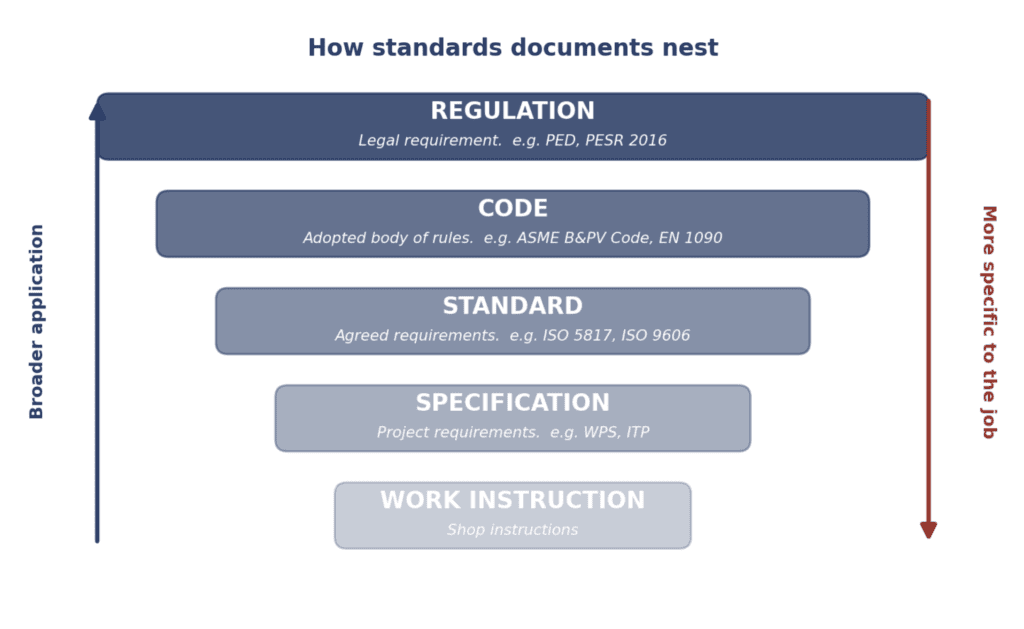
Figure 1: How standards documents nest. Regulations have the broadest authority and apply to anyone in the jurisdiction. Codes adopt rules across whole sectors. Standards address particular topics. Specifications are tailored to a specific project. Work instructions tell the shop floor how to carry out that project.
Each level inherits from the level above. A WPS must conform to the welding standard it cites. The welding standard must conform to the code that adopts it. The code must conform to the regulation that gives it legal force. The inspector reads each document at the level needed and checks compliance up and down the stack.
| A common confusion: ASME is both a code and a standards body
ASME (the American Society of Mechanical Engineers) is the organisation. The ASME Boiler and Pressure Vessel Code is the code it publishes, divided into sections. ASME also publishes standards under various designations (ASME B16, ASME B31, ASME Y14 and others). When a drawing or contract refers to “ASME IX”, it means Section IX of the ASME Boiler and Pressure Vessel Code. When it refers to ASME B31.3 it means the ASME Code for Process Piping, which is a separate code under ASME. The same is true of AWS, which publishes both codes (D1.1, D1.6 etc.) and standards (A2.4, A3.0 etc.). |
A standards reference looks more complex than it is. Once the conventions are understood, the same reference appears across nearly every welded fabrication. Each part of the citation tells you something.
BS EN ISO 17637
The most common prefix on a UK welding standard. BS means the British Standards Institution has adopted it. EN means it is also a European Norm, adopted by CEN, the European Committee for Standardisation. ISO means the underlying document is an International Organization for Standardization publication, adopted internationally. Where all three prefixes appear, the same technical document is in force in the UK, across Europe, and internationally. The four-digit number identifies the specific document.
BS EN, BS ISO, and BS alone
Not every standard carries all three prefixes. BS EN means the document is a European Norm adopted by BSI but with no ISO equivalent. BS ISO means an ISO document adopted by BSI without going through the CEN route. BS alone means a purely British standard. Where a BS EN exists in parallel with a BS EN ISO version, the BS EN ISO normally takes precedence and the older BS EN may be withdrawn.
Parts and sub-parts
Many welding standards are published in parts. BS EN ISO 9606 is the welder qualification standard for fusion welding. Its parts cover different materials. Part 1 covers steels. Part 2 covers aluminium. Part 3 covers copper. Part 4 covers nickel. Part 5 covers titanium and zirconium. A standard reference such as BS EN ISO 9606-2 means Part 2 specifically. A reference to BS EN ISO 9606 with no part number means the family as a whole.
Two systems dominate global welding fabrication. The European system, built around ISO standards, CEN European norms, and the relevant EU directives. The American system, built around ASME, AWS, and ANSI. Both produce safe fabrication. They take different routes to get there. An inspector working internationally needs to recognise both.
| Topic | European / ISO route | American route |
|---|---|---|
| Welding procedure content | BS EN ISO 15609 | ASME Section IX, AWS D1.1 |
| Welding procedure qualification | BS EN ISO 15614 | ASME Section IX, AWS D1.1 |
| Welder qualification | BS EN ISO 9606 (Parts 1 to 5) | ASME Section IX, AWS D1.1 |
| Welding coordination | BS EN ISO 14731 | (no direct equivalent, requirements within the code) |
| Welding quality requirements | BS EN ISO 3834 (Parts 1 to 4) | (no direct equivalent, requirements within the code) |
| Weld acceptance (steel) | BS EN ISO 5817 | Acceptance criteria within each code (e.g. AWS D1.1 Clause 8) |
| Visual inspection | BS EN ISO 17637 | AWS D1.1 Clause 8, ASME Section V Article 9 |
| NDT personnel qualification | BS EN ISO 9712 | ASNT SNT-TC-1A, ACCP, ASME Section V |
| Structural steelwork (execution) | BS EN 1090-1, BS EN 1090-2 | AWS D1.1 Structural Welding Code, Steel |
| Pressure equipment (rules) | PED 2014/68/EU, PESR 2016, EN 13445 | ASME Section VIII |
| Material certification | EN 10204 (Type 3.1, 3.2) | ASTM, ASME II material specifications |
The two systems are not interchangeable. A welder qualified to ASME Section IX is not automatically qualified to work to BS EN ISO 9606. A WPS qualified to ASME Section IX is not automatically valid for work to BS EN ISO 15614. Where work crosses systems, the contract should state which code or set of standards governs, and qualifications, procedures, and acceptance criteria must all be valid under that governing document.
On top of the general systems, individual sectors add their own requirements. These do not replace the underlying code or standard. They overlay specific requirements on top of it.
Oil and gas
NORSOK standards apply on the Norwegian Continental Shelf and are widely adopted internationally for offshore oil and gas. NORSOK M-101 is the standard for structural steel fabrication on offshore installations. API standards apply across the upstream and midstream oil and gas industry. API 1104 covers welding of pipelines and related facilities. API 5L covers line pipe. Where NORSOK or API governs, the underlying welding qualification and inspection requirements still apply but are tailored by the sector standard.
Pressure equipment in the EU and UK
PED 2014/68/EU sets the essential safety requirements for pressure equipment placed on the EU market. PESR 2016 is the equivalent UK regulation. Manufacturers demonstrate compliance through harmonised standards, of which EN 13445 (unfired pressure vessels) and EN 13480 (industrial piping) are the most widely used. Both call up the welding standards listed above. Inspection is carried out under one of the conformity assessment modules in PED Annex III, ranging from manufacturer self-declaration for the lowest hazard categories up to notified body involvement for the highest.
Rail
Rail welding fabrication follows sector-specific requirements that overlay the underlying EN 1090 framework. EN 15085 governs welding of railway vehicles and components, and divides manufacturers and inspection into CL1 to CL4 certification levels by safety class. The base welding qualification standards (BS EN ISO 9606, BS EN ISO 15614) apply, with additional rail-specific requirements on documentation, traceability, and inspector qualifications.
Structural steelwork
In the European framework, EN 1090 (Parts 1 to 3) governs the execution of steel and aluminium structures. EN 1090-2 covers steel and divides work into execution classes EXC1 to EXC4 by structural consequence. Higher execution classes require more rigorous welding quality management (BS EN ISO 3834 levels), more rigorous welder qualification, and more inspection. In the American framework, AWS D1.1 governs structural steel welding directly and uses its own categorisation of statically and cyclically loaded structures.
Conflicts between documents come up often. The drawing calls up one acceptance criterion, the WPS another. The standard cited in the contract is older than the one the supplier proposes. The client specification is tighter than the code. An inspector with no rule for resolving these is paralysed. The rule is straightforward.
NECIT works against any applicable international standard. Bulletins, certifications, and inspection reports cross the European, American, and sector-specific systems as the job requires.
Welding Certification.
Our welding certification scheme operates under two distinct accreditations. ISO/IEC 17024 accreditation covers certification of welders and operators against any applicable international standard, including BS EN ISO 9606 (in its parts for steels, aluminium, and other metals), ASME Section IX, AWS D1.1, and the equivalents used in other sectors. Separately, our ISO/IEC 17020 inspection body accreditation covers the witnessing of welding procedure qualification record test coupons and the associated mechanical testing, against BS EN ISO 15614, ASME Section IX, AWS D1.1, and other international procedure qualification standards. The two accreditations are kept separate because they cover separate activities defined by different standards.
Vendor Inspection.
Our Vendor Inspection division witnesses inspection and test activities against the codes and standards that govern the job. The scope covers structural steelwork (EN 1090, AWS D1.1), pressure equipment (PED, PESR, ASME), oil and gas (NORSOK, API), rail (EN 15085), and subsea fabrication. An inspector working on behalf of NECIT is required to know which document governs and to report against it accurately.
NDT and Testing.
Our UKAS accredited NDT division applies inspection methods to the acceptance criteria in the code or standard that governs the job. Personnel are certified to BS EN ISO 9712, and visual inspection is carried out in accordance with BS EN ISO 17637, with reference to BS EN ISO 5817 acceptance levels for steel or the equivalent acceptance criteria in the relevant ASME, AWS, or sector code.
American Society of Mechanical Engineers, ASME Boiler and Pressure Vessel Code, Section IX: Welding, Brazing, and Fusing Qualifications, ASME, New York.
American Welding Society, AWS D1.1, Structural Welding Code, Steel, American Welding Society, Miami, FL.
Robert W. Messler, Jr., Principles of Welding: Processes, Physics, Chemistry, and Metallurgy, Wiley, 1999.
