Pure aluminium is soft. Its yield strength in the annealed condition sits at around 25 to 40 MPa, which is too low for any structural application. Everything useful that aluminium does in engineering depends on what is added to it and how it is processed.
The aluminium alloy designation system exists because of this. Each alloy series is defined by its principal alloying element, and each element changes the balance of strength, corrosion resistance, formability, castability, and weldability in different ways. Getting the alloy selection right is the first decision in any aluminium fabrication project. Getting it wrong cascades into every stage that follows: welding procedure, filler metal, heat treatment, and inspection.
This bulletin works through the wrought aluminium alloy series, explains what each alloying element does and why, covers the two fundamentally different routes to strengthening aluminium, and explains why aluminium welding and inspection demand different thinking from steel.
Pure aluminium has useful properties.
It is light, with a density of about 2,700 kg per cubic metre, roughly one third that of steel. It has excellent corrosion resistance because it forms a thin, tenacious oxide layer that protects the surface. It has high thermal and electrical conductivity. It is readily formable and easily recycled.
What it does not have is strength. At 25 to 40 MPa yield in the commercially pure condition, it cannot carry structural loads. The addition of alloying elements, sometimes in very small quantities, transforms aluminium from a soft conductor into a structural material with yield strengths exceeding 500 MPa in the highest performance grades.
The trade-off is that every addition that raises strength changes something else. Copper raises strength dramatically but reduces corrosion resistance. Magnesium raises strength and improves corrosion resistance but introduces susceptibility to stress corrosion cracking at higher concentrations. Silicon improves castability and wear resistance but reduces ductility. The job of alloy design is to balance these effects for the intended application.
Wrought aluminium alloys are classified into eight series, numbered 1xxx to 8xxx. Each series is defined by its principal alloying element. The system is maintained by the Aluminum Association and the numbering is used worldwide.
The first digit identifies the series and therefore the principal alloying element. The second digit indicates modifications to the original alloy. The last two digits identify the specific alloy within the series, or in the 1xxx series they indicate the minimum aluminium purity. Figure 1 summarises the system.
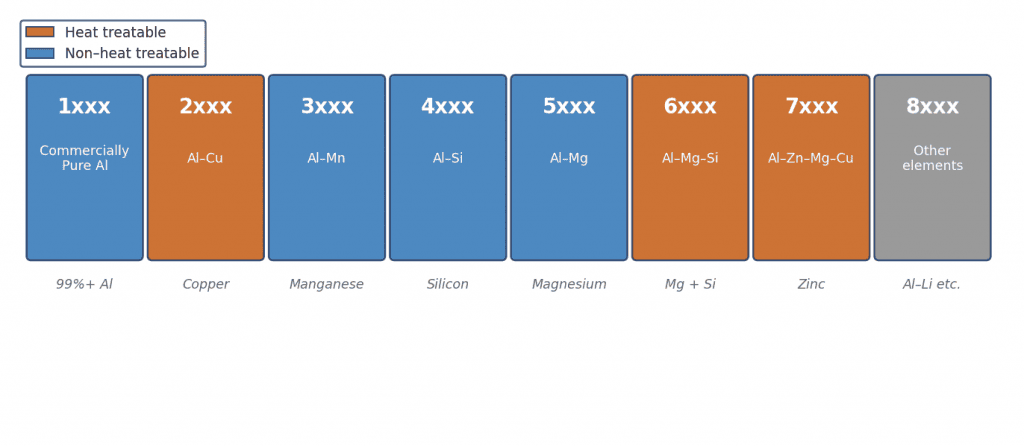
Figure 1: Classification of wrought aluminium alloy series by principal alloying element, showing whether each series is heat treatable and their representative applications.
The single most important division within this system is between non-heat-treatable alloys and heat treatable alloys. This determines how the alloy is strengthened, how it responds to welding, and what happens in the heat affected zone. The following sections cover each series in turn, weighted towards the grades that matter most in fabrication and inspection.
The 1xxx series covers commercially pure aluminium with a minimum purity of 99.00 percent. Grades such as 1050 (99.50 percent Al) and 1100 (99.00 percent Al) are typical. These alloys are non-heat-treatable. They can be strengthened only by cold work.
Their properties are those of nearly pure aluminium: excellent corrosion resistance, high thermal and electrical conductivity, high ductility, and very low strength. They are used for electrical bus bar and conductor, chemical process equipment, foil, heat exchanger fins, and reflectors. They are readily weldable. The weld and heat affected zone will be in the annealed condition regardless of the parent temper.
The 2xxx series uses copper as the principal alloying element, typically at 0.5 to 6.0 percent. These are heat treatable alloys. Copper provides powerful precipitation hardening through the formation of Al₂Cu and related phases during ageing.
Grades such as 2024 and 2014 are the backbone of aerospace structural applications, where their high strength to weight ratio justifies the higher cost and processing complexity. 2219 is used in cryogenic applications and welded aerospace structures.
The penalty for copper is reduced corrosion resistance. Copper creates galvanic potential differences within the microstructure, making 2xxx alloys susceptible to intergranular corrosion and stress corrosion cracking. They are often clad with a thin layer of pure aluminium (Alclad) to restore surface corrosion resistance.
Most 2xxx alloys are considered difficult to weld or unweldable by conventional arc welding because of their high susceptibility to solidification cracking. The exception is 2219, which is weldable and has been used in welded aerospace structures including rocket fuel tanks. Filler metal selection is critical. 2319 or 4043 are typical choices for 2219. Copper also improves machinability, which is why free machining 2xxx grades are used for screw machine products.
The 3xxx series uses manganese as the principal alloying element, at around 0.2 to 1.5 percent. These are non-heat-treatable alloys. Manganese provides moderate solid solution strengthening and, importantly, forms fine Al₆Mn dispersoid particles during processing that refine the grain structure and retard recrystallisation.
Grades such as 3003 and 3105 offer about 20 percent higher strength than 1xxx alloys while retaining good formability and corrosion resistance. Manganese also improves resistance to corrosion in sea water and industrial atmospheres. These alloys are used for beverage cans, heat exchangers, roofing sheet, cooking utensils, and general sheet metal work.
3xxx alloys are readily weldable. The heat affected zone softening is modest because the strength increase over pure aluminium is itself modest.
The 4xxx series uses silicon as the principal alloying element, typically at 4 to 13 percent. Silicon has a distinctive role. It lowers the melting point of aluminium and dramatically improves fluidity in the molten state.
This makes 4xxx alloys the standard choice for welding filler metals and brazing alloys. Grades 4043 and 4047 are among the most widely used aluminium welding filler wires. 4043 contains approximately 5 percent silicon and is used for welding 6xxx series alloys and many other combinations. 4047 contains approximately 12 percent silicon and offers even better fluidity and reduced solidification cracking susceptibility.
Silicon also increases strength somewhat through solid solution strengthening and improves wear resistance. As wrought structural alloys the 4xxx series has limited use. Some grades are used for forged engine pistons where wear resistance from the hard silicon particles is beneficial. The excellent castability of high silicon aluminium alloys is why the Al-Si system also forms the basis of the most common aluminium casting alloys (the 4xx.x cast series).
The 5xxx series uses magnesium as the principal alloying element, at 0.2 to 6.0 percent. These are non-heat-treatable alloys. Magnesium provides effective solid solution strengthening and gives the best combination of strength and corrosion resistance available in the non-heat-treatable aluminium alloys.
This is the workhorse series for welded aluminium fabrication. Grades 5083, 5086, 5052, and 5754 are widely used in marine structures, ship hulls, pressure vessels, storage tanks, transport containers, and structural applications where weldability and corrosion resistance are both required. 5083 is the most common structural aluminium alloy for welded marine and cryogenic applications.
Magnesium also improves resistance to sea water and alkaline environments, which is why 5xxx alloys dominate marine applications. It improves weldability relative to the copper bearing alloys. However, alloys with more than about 3 percent magnesium are susceptible to sensitisation over time at temperatures between roughly 50 and 200 degrees Celsius. In that range, the beta phase (Al₃Mg₂) can precipitate preferentially at grain boundaries, making the alloy vulnerable to intergranular corrosion and stress corrosion cracking. This is particularly important for marine vessels where prolonged exposure to moderately elevated temperature can sensitise hull plate over years of service.
5xxx alloys are welded with 5356, 5183, or 5556 filler metals, or with 4043 where solidification cracking resistance is the priority. The heat affected zone in a cold worked 5xxx alloy will recrystallise and soften to the annealed condition close to the weld, removing the work hardening. This is predictable and is accounted for in design by using the annealed strength for the joint, not the cold worked strength.
The 6xxx series uses the combined addition of magnesium and silicon as the principal alloying system, typically 0.4 to 1.2 percent of each. These are heat treatable alloys. The Mg₂Si precipitate that forms during ageing provides the age hardening response.
Grades 6061, 6082, and 6063 are among the most widely used aluminium alloys in the world for general structural and architectural purposes. 6082 is the standard structural alloy in European practice, used for bridges, platforms, vehicle structures, offshore modules, and marine superstructures. 6063 is the standard architectural extrusion alloy, used for window frames, curtain walling, and architectural fittings. 6061 is the general purpose structural alloy in North American practice.
The 6xxx series offers excellent extrudability. Complex hollow and multi-void cross sections are commercially produced in 6xxx alloys that would be difficult or impossible in other alloy systems. The combination of medium strength, good formability, good corrosion resistance, and excellent extrudability is why 6xxx alloys dominate the structural and architectural aluminium market.
The welding implications are significant. Welding dissolves or over-ages the Mg₂Si precipitates in the heat affected zone, and the joint efficiency (ratio of joint strength to parent strength) in a T6 temper 6xxx alloy is typically only 50 to 65 percent. The heat affected zone strength drops to approximately the annealed or naturally aged condition. This is not a defect. It is a fundamental design constraint. Structural aluminium design codes such as BS EN 1999 (Eurocode 9) use reduced allowable stresses for welded connections in heat treatable alloys precisely because of this.
Filler selection matters. 4043 is the default filler for 6xxx alloys because its silicon content widens the solidification range and reduces hot cracking susceptibility. Where higher weld metal strength is needed, 5356 can be used, but it carries a higher cracking risk on 6xxx parent.
The 7xxx series uses zinc as the principal alloying element, typically 0.5 to 8.0 percent, combined with magnesium and often copper. These are heat treatable alloys and produce the highest strengths in the wrought aluminium system.
7xxx alloys divide into two practical groups. The Al-Zn-Mg-Cu alloys such as 7075, 7050, and 7150 achieve the highest strengths and are the backbone of aerospace primary structure: wing skins, fuselage frames, and bulkheads. These alloys are generally not considered weldable by conventional arc welding because of extreme susceptibility to hot cracking and stress corrosion cracking.
The Al-Zn-Mg alloys without copper, such as 7020 and 7005, are weldable and are used in military vehicles, armoured structures, rail rolling stock, and bridge structures. They have a useful property. After welding, the heat affected zone naturally ages at room temperature and recovers a significant proportion of its original strength over a period of weeks. This natural ageing recovery does not occur in most other heat treatable aluminium alloys and is one reason 7020 is attractive for structural applications where welding is required.
The corrosion resistance of 7xxx alloys is generally lower than 5xxx or 6xxx, particularly in the copper bearing grades. Stress corrosion cracking is a significant concern, and temper selection (T73, T76, T74 overaged tempers) is often a deliberate trade of peak strength for improved stress corrosion cracking resistance.
The 8xxx series is a catch-all for alloys with principal alloying elements that do not fit the other seven series. The most significant are the aluminium lithium alloys.
Lithium is the lightest metallic element. Each one percent of lithium added to aluminium reduces density by approximately 3 percent and increases elastic modulus by about 6 percent. This combination of lower weight and higher stiffness makes Al-Li alloys extremely attractive for aerospace structures where every kilogram matters. Modern alloys such as 2195 and 2050 are used in aircraft fuselage, wing, and spacecraft structures.
Al-Li alloys are weldable but require specialised procedures and tight control of joint cleanliness. Their cost and processing difficulty restrict them to high performance aerospace applications. Iron bearing 8xxx alloys such as 8011 and 8079 are used for aluminium foil and thin gauge packaging. These are commodity products rather than structural alloys.
The most fundamental division in the aluminium alloy system is between non-heat-treatable and heat-treatable alloys.
Figure 2 shows which series fall into each category.
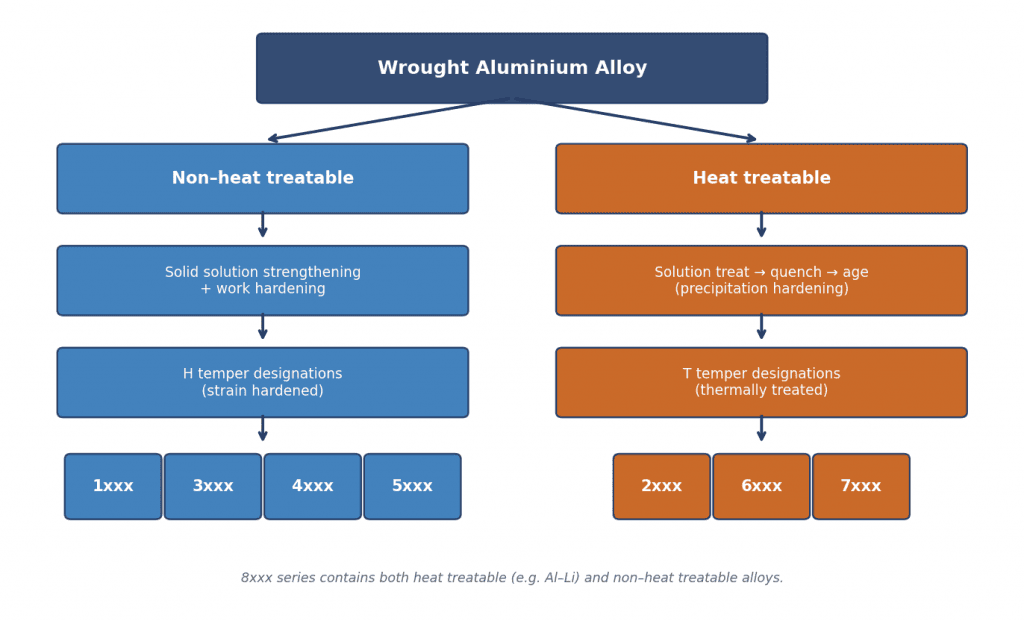
Figure 2: The two strengthening routes for wrought aluminium alloys. Non-heat-treatable alloys (1xxx, 3xxx, 4xxx, 5xxx) are strengthened by cold work and carry H temper designations. Heat treatable alloys (2xxx, 6xxx, 7xxx) are strengthened by precipitation hardening and carry T temper designations.
Non-heat-treatable alloys (1xxx, 3xxx, 4xxx, 5xxx) cannot be strengthened by heat treatment. Their only route to increased strength is cold work: rolling, drawing, or forming below the recrystallisation temperature, which multiplies dislocations and raises the yield strength. These alloys carry H temper designations. H12 means strain hardened to quarter hard condition. H14 is half hard. H18 is full hard. The O temper indicates fully annealed.
Heat treatable alloys (2xxx, 6xxx, 7xxx, and some 8xxx) can be strengthened by a controlled heat treatment sequence: solution treatment at high temperature to dissolve the alloying additions, quenching to retain them in supersaturated solution, then ageing at moderate temperature to precipitate fine strengthening particles. These alloys carry T temper designations. T4 means solution treated and naturally aged. T6 means solution treated and artificially aged to peak strength. T7 means solution treated and overaged for improved corrosion resistance at the expense of some strength.
This division is not academic. It determines everything about how the alloy responds to welding. In a non-heat-treatable alloy, the heat affected zone loses its cold work and softens to the annealed condition. In a heat treatable alloy, the heat affected zone loses its precipitation hardening and softens because the precipitates dissolve or coarsen. The two routes produce different heat affected zone profiles, different joint efficiencies, and different design implications.
Several alloying elements play important roles in aluminium alloys without defining a series of their own. Their effects are significant for fabrication and service performance.
Iron is present in all commercial aluminium as an impurity, typically at 0.1 to 0.7 percent. It is generally unwanted. Iron decreases ductility and toughness, forms brittle intermetallic compounds (Al-Fe-Si), reduces corrosion resistance by creating galvanic couples within the microstructure, and worsens castability. It is kept as low as economically achievable. Higher purity aluminium is more expensive precisely because of the cost of removing iron.
Titanium is added at very low levels, typically 0.02 to 0.2 percent, as a grain refiner. It forms fine TiAl₃ particles that act as nucleation sites during solidification, producing a finer grain structure with improved mechanical properties and better resistance to solidification cracking. Titanium has no adverse effect on formability and slightly improves corrosion resistance. It is routinely added to aluminium welding filler wire for the same reason: to refine the weld metal grain structure.
Chromium is added at 0.1 to 0.4 percent. Its primary role in aluminium alloys is to improve resistance to stress corrosion cracking in Al-Mg alloys. It forms fine dispersoid particles that inhibit recrystallisation and grain boundary migration. In the 5xxx series, chromium additions help control the precipitation of the beta phase at grain boundaries, which is the mechanism of sensitisation.
Nickel at 0.05 to 0.5 percent increases strength retention at elevated temperatures. It is used in certain heat resistant aluminium alloys for applications such as engine components, but has no significant role in the structural and marine alloys most relevant to fabrication.
Zirconium, scandium, and vanadium are used in small quantities in advanced alloys. Zirconium forms fine Al₃Zr dispersoids that are highly effective at controlling grain structure. Scandium is the most potent grain refiner and precipitation strengthener known for aluminium, but its cost restricts its use to high performance aerospace and sporting goods. These elements appear in 8xxx and specialised 7xxx alloys.
Fabricators who move from steel to aluminium welding encounter a material that behaves differently at every stage. The differences are not cosmetic. They affect joint integrity and require different procedures, different consumables, and different inspection approaches.
The oxide film: Aluminium forms a tenacious oxide layer (Al₂O₃) on its surface almost instantly when exposed to air. This oxide melts at approximately 2,072 degrees Celsius, whereas the aluminium beneath it melts at around 660 degrees Celsius. Unless the oxide is removed before and during welding, it will not melt when the parent metal does. It sits as inclusions in the weld, trapping contamination and preventing proper fusion. Alternating current TIG welding solves this: the electrode positive half cycle breaks and disperses the oxide. For MIG welding, mechanical or chemical cleaning before welding is standard practice.
Thermal conductivity: Aluminium conducts heat at roughly four times the rate of steel. The welding heat dissipates rapidly into the surrounding parent metal. This means higher heat input or preheat may be needed on thicker sections to achieve fusion, particularly at the start of a weld before the joint has warmed up.
No colour change before melting: Steel glows red, orange, and white as it heats, giving the welder a visual indicator of temperature. Aluminium does not. It goes from solid to liquid with no colour change. This makes the process less forgiving and the welder more reliant on technique, travel speed, and puddle observation.
Hydrogen porosity: Aluminium in the liquid state dissolves hydrogen readily. On solidification, the solubility drops sharply and the hydrogen comes out of solution as gas pores. This makes aluminium welding highly susceptible to porosity. Moisture on the parent metal surface, moisture in the shielding gas, hydrocarbon contamination on the wire or workpiece, and atmospheric humidity all contribute. Joint cleanliness and shielding gas quality (argon or argon-helium) are critical. This is a process control issue, not a metallurgical defect, and it is preventable with good practice.
Hot cracking (solidification cracking): Many aluminium alloys are susceptible to cracking during solidification if the weld composition falls in an unfavourable range. This is why filler metal selection in aluminium is fundamentally different from steel. In steel, the filler is chosen primarily to match the parent metal composition and strength. In aluminium, the filler is chosen to shift the weld pool composition away from the cracking range, even though this means the weld metal composition does not match the parent. The 4043 filler used on 6xxx parent is the classic example: the silicon content of 4043 is nothing like that of 6082, but it makes the weld resistant to cracking.
The heat affected zone in an aluminium weld behaves very differently depending on whether the parent metal is in the work hardened condition or the precipitation hardened condition.
In a work hardened (H temper) alloy such as 5083-H321, the heat affected zone closest to the weld reaches temperatures above the recrystallisation temperature and the cold work is removed. The material softens to the annealed (O temper) condition in that region. The transition from softened heat affected zone to full strength parent metal is relatively gradual. The design response is simple: use the annealed strength for the joint. The weld metal strength with appropriate filler is typically close to the annealed parent strength.
In a precipitation hardened (T temper) alloy such as 6082-T6, the heat affected zone behaviour is more complex and more consequential. Figure 3 shows a schematic hardness traverse across such a weld.
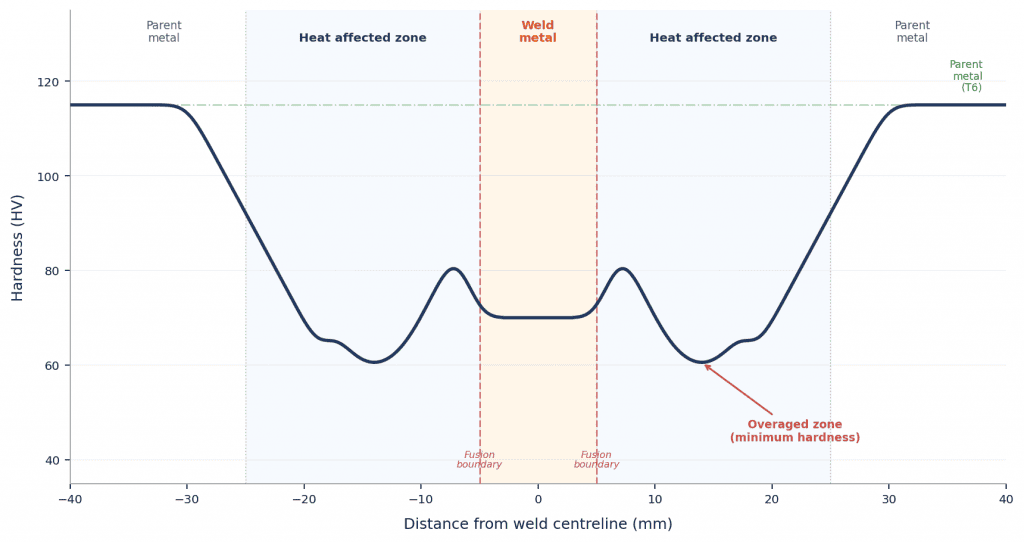
Figure 3: Schematic hardness traverse across a butt weld in a heat treatable aluminium alloy (e.g. 6082-T6 welded with 4043 filler). The overaged zone in the heat affected zone is the region of minimum hardness, where the strengthening precipitates have coarsened and lost their effectiveness.
Schematic. Hardness values and distances are representative of the general trend, not measured data for a specific procedure.
Close to the fusion boundary, peak temperatures are high enough to dissolve the Mg₂Si precipitates back into solution. On cooling, this region may naturally age over time and recover some strength. Further out, the peak temperature is lower but still high enough to coarsen the precipitates, destroying their effectiveness as obstacles to dislocation motion. This is the overaged zone, and it is where the minimum hardness occurs. It typically sits 10 to 20 mm from the fusion boundary, depending on heat input and joint geometry. Further out still, the peak temperature is too low to affect the precipitates significantly, and the parent metal retains its full T6 properties.
The result is the characteristic hardness valley visible in Figure 3. The joint efficiency of a 6xxx-T6 weld is governed by this valley, not by the weld metal or the fusion boundary. In a typical single pass TIG weld in 6082-T6, the minimum heat affected zone hardness may fall to around 55 to 65 HV, compared to 100 to 120 HV in the parent T6 condition. Joint efficiencies of 50 to 65 percent are typical.
Filler metal selection for aluminium is summarised in the following table for the most common fabrication combinations.
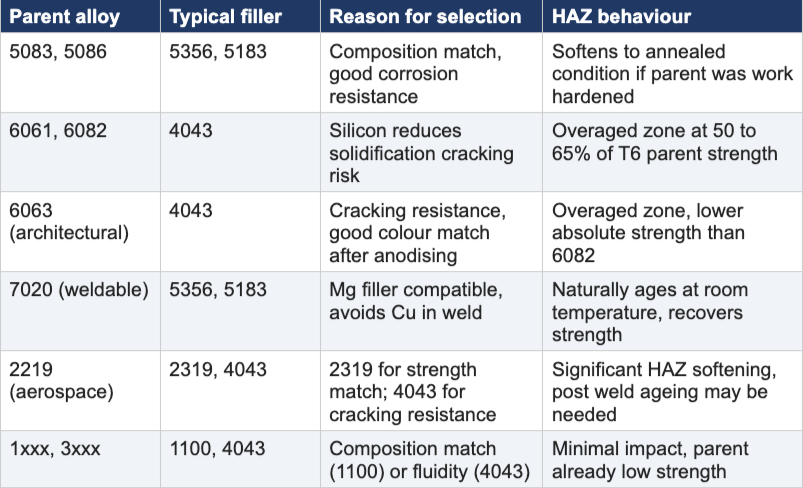
Two filler wires account for the majority of aluminium fabrication welding worldwide: 4043 and 5356. If the parent alloy is a 5xxx grade, 5356 is normally the first choice because it provides a better composition match and better corrosion resistance in marine environments. If the parent alloy is a 6xxx grade, 4043 is normally the first choice because it prevents solidification cracking. Using the wrong filler on the wrong parent is a common error with real consequences.
Aluminium is not a ferromagnetic material. This single fact eliminates magnetic particle inspection from the available surface inspection methods. On steel, MPI is the standard surface and near surface method for weld toes, heat affected zones, and surface breaking cracks. On aluminium it cannot be used at all.
Dye penetrant inspection replaces MPI for surface examination of aluminium welds and parent material. Eddy current inspection is also effective for surface and near surface flaw detection in aluminium, particularly for fatigue cracking in service, and is widely used in aerospace inspection.
Ultrasonic testing of aluminium welds is feasible but presents different challenges from steel. The acoustic properties of aluminium are different: lower density and higher sound velocity mean different probe calibration. The weld metal grain structure in aluminium is typically coarser than in equivalent steel welds, which can reduce signal to noise ratio. Phased array ultrasonic testing provides better coverage and defect characterisation capability in aluminium welds than conventional single probe techniques.
Porosity is the most common volumetric defect in aluminium welds, and it is detectable by ultrasonic methods. Lack of fusion defects, particularly associated with the oxide film, are the most serious. They can behave like planar flaws under load and are the defects that most directly threaten structural integrity.
The heat affected zone in a heat treatable aluminium alloy is not visible on the surface and produces no detectable indication by any surface inspection method. The softened overaged zone is a metallurgical condition, not a defect. It is confirmed by hardness traverse during welding procedure qualification, not by production NDT. This is why procedure qualification testing is so important in aluminium fabrication. The production weld may look visually acceptable and pass surface inspection while the heat affected zone carries only 50 to 65 percent of the parent metal strength. The procedure qualification is what demonstrates that this is accounted for in the design.
NECIT Services operates across three accredited divisions covering the verification activities relevant to aluminium fabrication and inspection.
Our welding certification scheme operates under two distinct accreditations. ISO 17024 accreditation covers certification of welders and operators under BS EN ISO 9606-2, ASME IX and AWS D1.2 across the parent material groups defined in the standard. Separately, our ISO 17020 inspection body accreditation covers the witnessing of welding procedure qualification record (WPQR) test coupons and the associated mechanical testing, including hardness traverses (if required), transverse tensile tests, Macro Testing, Micro Testing and bend tests. For aluminium procedures, the hardness traverse across the heat affected zone is particularly informative because it reveals the overaged zone profile and confirms the minimum joint strength. The Welding Development Centre (WDC), our sister company under NECIT Holdings, provides specialist welding procedure development and metallurgical consultancy for aluminium alongside the steel grades covered by our certification scheme.
Our Vendor Inspection division witnesses fabrication, welding, heat treatment, and final inspection at manufacturing facilities globally. For aluminium fabrication, this includes verifying material certification to the correct alloy and temper, confirming filler metal selection against the welding procedure, witnessing the welding and any post weld heat treatment, and reviewing the inspection records. The scope covers structural fabrication under BS EN 1090-3 (aluminium structures), pressure equipment under PED and the Pressure Equipment (Safety) Regulations, and transport and marine applications.
Our UKAS accredited NDT division applies the inspection methods appropriate to aluminium particularly to the Rail Industry and EN 15085, where NECIT holds RIS-2701-RTS under our schedule of accreditation for all of our NDT Methods. Dye penetrant inspection is used for surface examination of aluminium welds where MPI cannot be applied. Ultrasonic testing, including phased array UT, is used for volumetric examination of aluminium weld joints. Eddy
current inspection is applied for surface and near surface flaw detection. Visual inspection (VT) is the first line of examination on every aluminium weld. Personnel are certified to BS EN ISO 9712 level 2 as a minimum.
Sindo Kou, Welding Metallurgy, 3rd ed., Wiley, 2020.
Serope Kalpakjian and Steven R. Schmid, Manufacturing Engineering and Technology, 8th ed., Pearson, 2020.
George E. Dieter, Mechanical Metallurgy, 3rd ed. (SI Metric edition), McGraw-Hill, 1988.
NECIT: when what’s built must not fail.
